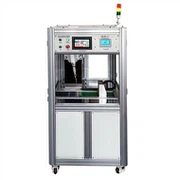
Characteristics And Advantages And Disadvantages Of Ultrasonic Metal Welding Machines
Nov 27, 2023
(1) The two welded objects overlap and are subjected to ultrasonic vibration pressure to form a solid form. The bonding time is short, and the bonding part does not produce casting microstructure (rough surface) defects.
(2) Compared with resistance welding methods, ultrasonic welding has a longer mold life, less time for mold repair and replacement, and is easy to achieve automation.
(3) Ultrasonic welding can be performed between the same metal and different metals, which consumes much less energy compared to electrical welding.
(4) Compared with other pressure welding methods, ultrasonic welding requires a lower pressure and less than 10% deformation, while cold pressure welding requires a workpiece deformation of 40% -90%.
(5) Ultrasonic welding does not require pre-treatment of the welded surface and post weld treatment like other welding methods.
(6) Ultrasonic welding does not require external factors such as flux, metal filler, or external heating.
(7) Ultrasonic welding can minimize the temperature effect of materials (the temperature of the welding zone does not exceed 50% of the absolute melting temperature of the welded metal), thereby avoiding changes in the metal structure, making it very suitable for welding applications in the electronic field.
High fusion strength;
Near cold processing, no annealing of the workpiece, and no oxidation marks;
After welding, the conductivity is good, and the resistance coefficient is extremely low or almost zero;
Low requirements for welding metal surfaces, both oxidation and electroplating can be used for welding;
The welding time is short and does not require any flux, gas, or solder.
Welding without sparks, environmentally friendly and safe. The metal parts to be welded should not be too thick, and the solder joints should not be too large, requiring pressure.