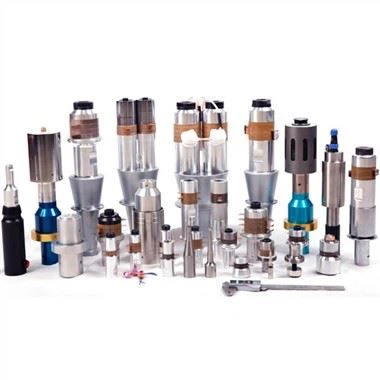
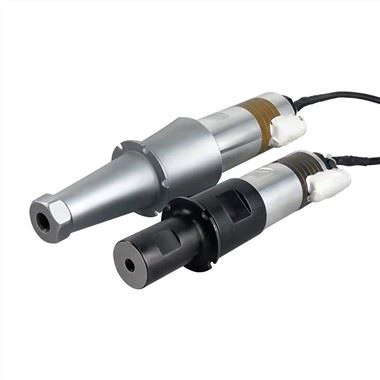
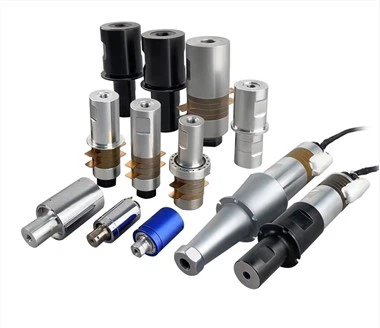
Ultrasonic Transducer


product key technologies
ultrasonic transducer
01.

Ultrasonic Transducer For Ultrasonic Welding Machine

● It is made of piezoelectric ceramic material, which has high        conversion efficiency and can be mass-produced.

● The size and shape of the Ultrasonic Transducer for Welding are specially designed to match the welder completely.

● The resonance impedance is small, the heat generation is small, the use temperature range is wide, and the reliability is high.

● Its output is stable and not easy to crack.

● The transducer has good electromechanical conversion efficiency under high power and high amplitude conditions.

● Frequency and static capacitance are consistent.

02.

Ultrasonic Transducer For Ultrasonic Cleaning Machine

  • High efficiency: The mechanical Q value of the Ultrasonic Cleaning Transducer is high, and the electroacoustic conversion efficiency is as high as 95% or more.
  • Strong amplitude: The vibrator has a high vibration velocity, and the amplitude is increased by more than 50% compared with the magnetostrictive vibrator.
  • Good heat resistance: wide temperature range, low resonance impedance, continuous operation and low heat generation.
  • Easy to install: just tighten with bolts. It is easy to install and has high reliability.
ultrasonic transdcuer


Products Showroom


First 1234 Last 1/4

Know more about Ultrasonic Transducer
 

Ultrasonic welding transducers, as the core components of ultrasonic welding technology, play an important role in various ultrasonic welding applications.

  • Technical advantages of ultrasonic transducer for welding

Efficient: Ultrasonic welding transducers can generate high-frequency ultrasonic waves, quickly complete welding work, and improve production efficiency.
Environmental protection and energy conservation: Ultrasonic welding technology does not require the use of any welding aids, reducing environmental pollution and harm to human health. Meanwhile, it also has lower energy consumption, saving energy costs for enterprises.
Precision welding: The ultrasonic welding transducer, driven by the ultrasonic welding generator, can achieve precise welding effects to ensure the quality of the welded products.
Strong applicability: Ultrasonic transducer for welder are suitable for welding various materials, such as metals, plastics, etc., providing reliable solutions for welding needs in various industries.
Easy to automate: Ultrasonic welding technology can be combined with automation equipment to achieve continuous and efficient welding operations, improving production efficiency.

Customization: Shenzhen Jiayuanda Technology Co., Ltd. can provide customized ultrasonic welding transducer solutions for customers in different industries and needs to meet personalized needs.


ultrasonic transducers
 
ultrasonic welding parts 9


ultrasonic welding parts 1
 
ultrasonic cleaning transducer
ultrasonic generator for cleaning


  • Installation position of ultrasonic transducer for cleaning

When customizing an ultrasonic cleaning machine, it is required that the vibration head should be placed on the side, while generally it is placed on the bottom. Is it better to place the vibration head on the bottom or the side? In fact, whether it is good or not depends on the specific situation. Generally, placing it on the bottom surface is convenient for assembly and not easy to damage, and the quality is more reliable. However, due to the special situation of some cleaning objects, the cleaning requirements for the side are higher. In this case, the cleaning effect of placing the vibration head on the bottom facing the side may not be ideal. If it is placed on the side, it can be directly facing the side of the object, and the effect is naturally more direct and effective. In theory, ultrasound uses water molecules to impact the surface of objects for cavitation, which means that any place where water comes into contact can be cleaned clean. On the contrary, installing the shock head on the side will have more quality issues, and generally speaking, it is not recommended to use the side form.

d

Company profile


JYD is a leading national high-tech enterprise specialized in the ultrasonic technology research and development. The main products include ultrasonic generator, ultrasonic transducer, ultrasonic horn, ultrasonic lace machine, ultrasonic cutting machine and other ultrasonic machine. Our products mainly applied in ultrasonic cleaning, ultrasonic welding, ultrasonic cutting and other customized ultrasonic application. All of our products are CE/FCC/ROHS certificated. Meticulous in aspects from core component, product strategy to supplier management, JYD team has been pursuing superior quality, concentrating on creating easily-operated, maintanience convenient, price moderate and quality reliable products to deliver you a delightful product experience.


Our Certificate

2700 2900


2900 2700


MAR - 3


MAR -1
productcate-735-550

Remarkable Service

All of our ultrasonic cleaning and ultrasonic welding core parts(ultrasonic transducer, ultrasonic generator and ultrasonic horn) has two years quality warranty and wholelife technical support


Pre-sales consultation

When get your inquiry of ultrasonic sealing sewing machine, our sales team will reply you within 2 hours; professional internatinal sales skills will let your order processing smoothly

Cost saving

One-stop service helps you choose products suitable for your market and budget, save time, and achieve win-win cooperation.

Installation service

Before the ultrasonic machine actual installation,we will communicate with the customer to understand the installation needs and requirements, our 10+ professional enginner team and 15+ sales team will be your strong basic support

After-sales service

All ultrasonic machine and ultrasonic parts has two years warranty(just ultrasonic horn has three months warranty), any of technical problem , please feel free to contact us(contact E-mail: sales@jydultrasonicequipments.com)

Win-win cooperation

Practice the concept of 'common development and common profit

FAQ

Q: Why does ultrasonic transducer need grounding protection?

A: Protect personal safety. It can prevent strong current from passing through the human body when the metal shell is charged due to insulation damage or accidents to ensure personal safety. Therefore, the grounding protection of the ultrasonic transducer is to protect personal safety. The function of the ultrasonic transducer is to convert the input electrical power into mechanical power (ie, ultrasonic waves) and then transmit it out, while consuming a small part of the power itself.

Q: Precautions for assembling various components of ultrasonic transducer

A: Various components of the ultrasonic vibration system, such as transducers, horns, tool heads and other major parts are connected through central bolts. 1. Check that the contact surface should be flat and smooth without scratches. If there are scratches, lightly polish them with metallographic sandpaper above zero. It is required that the defects can be smoothed without damaging the flatness of the contact surface. 2. Clean the screws, screw holes and contact surfaces with volatile, non-corrosive detergent. 3. Thoroughly clean the screws, screw holes and contact surfaces. 4. All connecting screw holes should be perpendicular to the contact surface. 5. Apply a thin layer of butter or Vaseline on the contact surface before tightening. Be careful not to apply it on the connecting screws and screw holes. 6. Carefully tighten the two parts. Control the appropriate tightening torque according to the specifications of the connecting screws. Where possible, tighten them appropriately. 7. If the joint surface is loosened again, no scars should be visible. 8. Touch the vibration system with your hands to see that the amplitude is uniform, there is no strange sound, and there is no serious local heating. 9. After working for a period of time, there should be no traces of oxidation or ablation when the joint surface is opened again. Otherwise, it means that the contact here is not good and the ultrasonic energy is seriously lost here.

Q: Ultrasonic transducer operating temperature

A: Ultrasonic transducers generate heat when used, which is mainly caused by three reasons. One is that the workpiece to be welded will generate heat, or the material treated by ultrasonic waves will generate heat, or the mold (tool head) or horn will generate heat after working for a long time, and this heat will be transferred to the transducer. The second is the power loss of the transducer itself. Since the energy conversion efficiency cannot be 100%, the lost energy must be converted into heat. The temperature rise will cause the parameters of the ultrasonic transducer to change, gradually deviating from the optimal matching state, and more seriously, the temperature rise will cause the performance of the piezoelectric ceramic chip to deteriorate. This in turn causes the ultrasonic transducer to work worse and heat up faster, which is a vicious cycle. Therefore, we must provide the ultrasonic transducer with good cooling conditions, usually air cooling at room temperature; if necessary, cold air cooling can also be used. Under normal circumstances, the temperature rise caused by these two points is also normal. Under normal cooling conditions, there will be no major problems.

Q: The ultrasonic transducer fell off, how to repair it?

A: If only one or two are lost, then there is no need to repair it. The method is to directly connect the power cord to another good transducer (note that the positive connection is connected to the positive one, and the negative connection is not required). If there is only one on a machine Or both transducers have fallen off, then you must repair them. Pay attention to the method when repairing: first check whether the dropped ultrasonic transducer is good. The method is: use a multimeter to check whether the positive and negative poles are grounded. If they are grounded, it proves that the ultrasonic transducer is broken (how to use the multimeter is not here) Talk) When gluing the transducer, if it is old, be sure to remove the original glue residue on the transducer. If possible, you can use a lathe to cut it. The purpose is to make the pasting surface clean. (As for how to handle it, it is up to you. Thinking about it) The bonding part of the tank body must also be cleaned, and the transducer can be pasted only when it is dry. Now let’s talk about the problems you will encounter: when replacing the transducer, you cannot find the same brand, especially the same frequency transducer, because the frequency of each manufacturer’s transducer is different from that of another manufacturer, so there are When replacing, pay attention to adjusting the ultrasonic generator to make the frequency more consistent as much as possible.

Q: Are the ultrasonic waves emitted by the ultrasonic transducer directional?

A: This depends on the structure of your transducer. For example, if your transducer is round and ground-emitting, it will be cone-type. The angle of emission is related to the emission area and emission frequency. If yours is cylindrical and the cylindrical emission is horizontal, it is non-directional. If it's spherical, it's omnidirectional. There is no directionality.

Q: Will the ultrasonic generator be damaged if it is turned on without connecting to the ultrasonic transducer?

A: Yes, it will be damaged (1) The indicator light of the ultrasonic generator does not light up and the fan does not rotate: the power switch is broken; the power fuse is blown. (2) The indicator light of the ultrasonic generator is on, the fan is running normally, and there is no ultrasonic wave: the connecting plug between the ultrasonic transducer and the ultrasonic output is loose; the DC fuse is blown; the ultrasonic generator bridge stack is broken; the ultrasonic generator power tube IGBT is broken; the ultrasonic replacement Energizer short circuit. (3) When the power switch of the ultrasonic generator is turned on, the overload light is on: the insulation resistance of the ultrasonic transducer is too small; the cable connected to the ultrasonic transducer is short-circuited or grounded; the voltage boost becomes short-circuited.

(0/10)

clearall