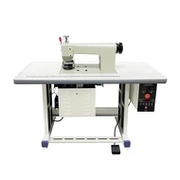
Ultrasonic Piercing Welding Head For 35KHz Non-standard Machine
Jul 16, 2022
Ultrasonic welding head material:
1. Aluminum magnesium alloy
With extremely high mechanical yield strength, appropriate hardness, strong thermal conductivity, appropriate price and easy processing, it is an ideal ultrasonic mold manufacturing material; However, aluminum is soft and not wear-resistant, which is easy to produce traces on the product surface during welding, and it is only applied to products with general welding requirements.
2. Titanium alloy
High toughness, high hardness, good thermal conductivity, strong stress resistance, moderate machinability. It is a kind of high-grade ultrasonic welding head making material which is more durable and wear-resistant than magnesium aluminum alloy. Widely used in medical, electronic, automotive, home appliances, non-woven fabric recycling and other industries, it is the preferred material for a variety of complex applications, such as high stress, continuous ultrasound, clean and quiet environment, high durability and so on; The cost is higher than that of magnesium aluminum alloy.
3. Imported alloy steel
After heat treatment, the hardness can reach 62~65 degrees, with high wear resistance, low thermal conductivity, low stress, high ultrasonic power loss, and great difficulty in machining. It is suitable for continuous cutting or welding applications requiring high wear resistance. Because of wear resistance, the use cost is low, but the manufacturing process is complex, and the price of good imported alloy steel is also very expensive.
Several professional parameters of ultrasonic welding head:
1. Ultrasonic welding head amplitude
Amplitude is a key parameter in welding. If the amplitude is not enough, the welding cannot be done or the welding strength is poor. If the amplitude is too high, the raw material surface will be scalded and the plastic structure will be damaged, resulting in poor strength. Whether the design output of welding head amplitude is achieved and the uniformity of welding surface amplitude distribution are the key factors to measure the quality of a welding head. Good welding head design brings the best vibration effect and longer service life.
2. Ultrasonic welding head frequency
The working frequency of the welding machine is mainly determined by the mechanical resonance frequency of the transducer, the amplitude modulator and the welding head (hereinafter referred to as the ultrasonic triplet). The generator automatically tunes the frequency according to the resonance frequency of the triplet, so that the working output frequency of the generator is consistent with the triplet frequency. Taking 20kHz as an example, the automatic frequency tracking range is ± 0.5 kHz. As long as the resonance frequency of the triplet is within this range, the generator can work normally.
There is a deviation between the factory default frequency of transducers and amplitude modulators from different manufacturers, and the new welding head needs to be slightly modified in strict accordance with the resonant frequency of ultrasonic equipment manufacturers. With 20kHz welding head, the welding head frequency will control the central frequency range of 19.90-20.10khz.
3. Power loss of ultrasonic welding head
When the transducer, amplitude modulator and welding head are used, they are locked together by two machine screws. When two end surfaces are in contact, the amplitude of the contact surface is the largest and the stress is the smallest. When the design or manufacture of the welding head is unreasonable, the ultrasonic manual test will cause abnormal howling, and the body of the triplet is hot, resulting in high power loss. When the power loss exceeds 5% or more of the total power output of the equipment, we decide that the triplet is not suitable for use at this time, and further testing is needed. It has been confirmed whether it is due to insufficient assembly locking force, or which part of the welding head, amplitude modulator and transducer is damaged.