


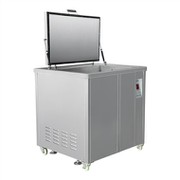
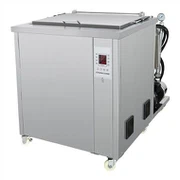
Engine Parts Ultrasonic Cleaning Machine
The special ultrasonic cleaning machine is suitable for cleaning engine and gearbox parts. It can quickly and thoroughly clean the crankshaft, nozzle, engine block, cylinder head and gearbox housing...
Product Description:
Engine parts ultrasonic cleaning machine for engine components are industrial-grade systems designed specifically for metal parts such as engine blocks, cylinder heads, crankshafts, pistons, valves, fuel injectors, turbochargers, and bearings used in automobiles and construction machinery. Utilizing medium-to-low frequency (28/40 kHz) high-power ultrasound combined with high-temperature degreasing solutions, the machine harnesses the cavitation effect to dislodge accumulated engine oil deposits, metal shavings, grinding paste, anti-rust oil, and sludge from internal oil passages, threads, and crevices. Often equipped with features such as circulating filtration, oil-water separation, high-pressure spraying, and vertical agitation (lifting/oscillating), the system ranges from single-tank unit to fully automated multi-tank line. It is suitable for cleaning used engine parts in repair shops as well as for mass-producing, cleaning, and derusting new components in manufacturing plants. Capable of thorough cleaning without damaging precision mating surfaces, the machine effectively replace manual scrubbing and high-pressure rinsing, thereby enhancing cleaning efficiency and the precision of parts assembly.
| Specification of Engine Parts Ultrasonic Cleaning Machine | ||||||
| Model | Capacity (Liter) | Ultrasonic Frequency (KHz) | Ultrasonic Power(W) | Heating Power (W) | Transducers Qty (PCS) | Inner tank dimednsion (MM) |
| JYD-1012SG | 45 | 25/28/40 | 600 | 1500 | 12 | 500*300*300 |
| JYD-1018SG | 61 | 25/28/40 | 900 | 2000 | 18 | 500*350*350 |
| JYD-1024SG | 88 | 25/28/40 | 1200 | 3000 | 24 | 550*400*400 |
| JYD-1030SG | 108 | 25/28/40 | 1500 | 3000 | 30 | 600*450*400 |
| JYD-1036SG | 147 | 25/28/40 | 1800 | 6000 | 36 | 650*500*450 |
| JYD-1042SG | 163 | 25/28/40 | 2000 | 6000 | 42 | 650*500*500 |
| JYD-1048SG | 175 | 25/28/40 | 2400 | 6000 | 48 | 700*500*500 |
| JYD-1060SG | 240 | 25/28/40 | 3000 | 9000 | 60 | 800*600*500 |
| JYD-1072SG | 300 | 25/28/40 | 3600 | 9000 | 72 | 1000*600*500 |
Product Features:
1. The cleaning tank is constructed from thickened S304/316L stainless steel, formed via integrated bending and welding. With a wall thickness of ≥1.5mm, it withstands strong alkaline degreasers, high-temperature oily residues, and the impact of metal chips.
2. The bottom features a reinforced load-bearing structure capable of supporting heavy castings such as engine blocks, cylinder heads, and crankshafts; it remains leak-free and corrosion-resistant during prolonged immersion.
3. Integrated mounting bases for ultrasonic transducers are welded to the tank bottom, ensuring vibration resistance and secure attachment.
4. Equipped with an independent digital ultrasonic generator featuring a frequency-sweeping function and excellent heat dissipation performance.
5. Customizable with an external, independent filtration and circulation system, featuring a three-stage filtration setup: a coarse filtration basket, a magnetic iron-removal device, and a precision filter element.
6. Customizable with an electric lifting and oscillation mechanism; the workpiece basket moves up and down at a constant speed, ensuring thorough fluid circulation within oil passages, cooling channels, and threaded holes to effectively clean carbon deposits from deep holes and blind spots.

Application:
I. Gasoline Engine Parts (Passenger Vehicles, Motorcycles)
(1) Cylinder blocks, cylinder heads, pistons, piston rings, connecting rods, crankshafts, camshafts, valves, valve seats, valve springs
(2) Fuel injectors, fuel rails, throttle bodies, carburetors, intake manifolds, exhaust manifolds, spark plug housings
(3) Bearings, bearing shells, timing gears, oil pumps, water pumps, radiator coolant passage components, oil pans
II. Diesel Engine Parts (Trucks, Buses, Construction Machinery, Agricultural Machinery)
Diesel cylinder blocks and heads, high-pressure common-rail injectors, plunger assemblies, turbocharger assemblies, boost piping, hydraulic nozzles, diesel filter housings, construction machinery engine housings, flywheel housings
III. New Energy Vehicle Powertrain Components
Hybrid engine components, electric motor housings, motor end caps, reduction gear housings, gears, oil circuit valve bodies, aluminum cooling channel components, oil pump housings
IV. Turbocharger and Precision Valve Components
Turbine wheels, turbine housings, relief valves, check valves, hydraulic control valves, brake valves, oil pressure regulating valves, various valve bodies with intricate oil passages

FAQ:
Is a cleaning agent required for this ultrasonic cleaner?
Using only tap water or deionized water removes only loose surface dust; it cannot dissolve engine oil, carbon deposits, sludge, or gummy residues. Cavitation provides only physical detachment without chemical emulsification or decomposition, resulting in extremely low cleaning efficiency; it fails to clean carbon deposits from deep oil passages, and parts are prone to rapid re-rusting after cleaning. In the vast majority of operating scenarios, a specialized cleaning agent must be used.
Two common types of cleaning agents:
1) Water-based, alkaline, engine-specific degreasing cleaner (the most common type)
Suitable for cast iron, aluminum, and steel engine components. When heated, it rapidly emulsifies heavy oil, decomposes carbon deposits, and softens carbonized sludge. Combined with ultrasonic cavitation, it easily removes stubborn grime from crevices and oil passages. It also provides short-term rust protection, making parts resistant to rusting after cleaning.
Applications: Used parts during engine overhauls; removal of cutting fluids and anti-rust oils in factory machining.
2) Solvent-based cleaners (isopropyl alcohol, carbon-removing solvents, kerosene-based fluids)
Targeted at extremely thick carbon deposits, precision fuel injectors, and tiny valve orifices; offers faster carbon removal. Disadvantages include flammability (requiring explosion-proof equipment) and higher costs; rarely used in mass production.
Cleaning agents and ultrasonic waves work synergistically: ultrasonic waves loosen the grime while the cleaning agent dissolves the oil and dirt; only by combining the two can thorough cleaning be achieved. Without a cleaning agent, cleaning time increases exponentially, and significant carbon residue remains, which can compromise engine assembly and performance.
For more details of Engine Parts Ultrasonic Cleaning Machine, please feel free to contact us !




Send Inquiry
