What are the components of an ultrasonic welding system?
Jan 28, 2022
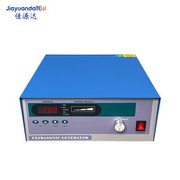
Ultrasonic generator
Ultrasonic generator, also known as ultrasonic electronic box, is used to transmit high-power AC flat rate signal to the mold, and to match the resonant frequency. High voltages of the respective ultrasonic frequencies are generated from the connected power supply voltages. All data related to the welding process are accurately measured and evaluated. The generator protects the vibration system from overload, keeps the amplitude constant and compensates for the vibration behavior of the respective welding joints.
1. The generator of ultrasonic welding machine with power above 500W adopts self-excited power oscillator, which has certain frequency tracking ability.
2. High power ultrasonic welding machine, the generator signal adopts phase-locked frequency automatic tracking circuit, so that the frequency of the generator output is basically consistent with the resonant frequency of the transducer.
Transducer
The transducer is the interface between the electrical and mechanical environment. It uses the inverse piezoelectric effect to transform the electrical vibration into mechanical longitudinal vibration and transmits it to the horn and welding head.
The amplitude
The Booster, often referred to as a Booster, amplifies or reduces the amplitude generated by the transducer. Because the horn is installed at the zero node position, it can be fixed on the ultrasonic welding machine through the zero node position to avoid the vibration arm deviation and transfer the welding force.
Welding mold, also known as welding head
Welding mold, also known as welding head welding head as a real active welding mold, used to place fixed plastic parts, the mechanical vibration is transferred to the welding parts, so that the high frequency vibration friction is accurately transmitted to the welding surface of the plastic parts. The welding head can also enlarge or decrease the amplitude according to the geometry. Generally speaking, they are customized according to the sample provided by customers. Ultrasonic transducers, amplifiers and ultrasonic welds make the vibration during welding resonate with ultrasonic frequencies (usually 20KHz, 25KHz, 35KHz and 40KHz).
Bottom die or bottom anvil
Ultrasonic welding refers to the welding joints in accordance with the way of material connection. Under the action of force, longitudinal vibrations are introduced into the plastic at frequencies of 20kHz, 30kHz and 35kHz and at welding head amplitudes of 5μm to 50μm. Ultrasonic vibrations are concentrated by the special structure of the weldment and die. These special structures in the weldment are called conduction angles. The contact points in the joint area deform according to the input of high frequency energy. Friction between the contact surface and the molecular chain creates heat that melts the material.