


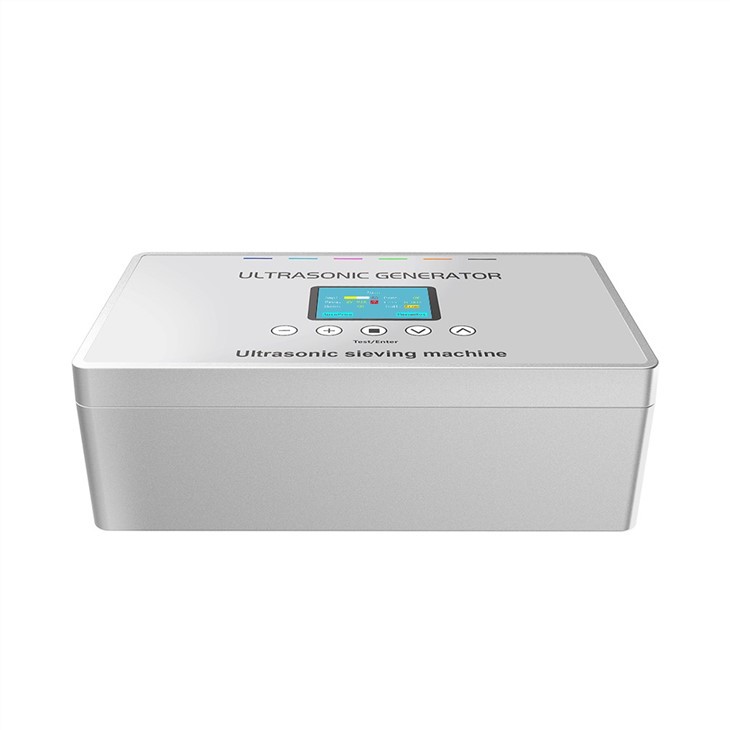
Ultrasonic Generator For Vibro Sieve
MAR series is a professional ultrasonic screening system, which is composed of ultrasonic generator and screen transducer. It can meet the use range of 28 ~ 38kHz frequency. The system can automatically track the best resonant frequency and compensate for the detuning caused by heating and other reasons; It can also be added to any new or existing vibrating screen.....
The ultrasonic generator for vibro sieve is the core component of the ultrasonic vibrating screen system. It is a special accessory to solve the problem of network blocking during the screening of fine materials or materials with special properties. The ultrasonic screening system consists of two components included ultrasonic generator for vibro sieve and ultrasonic transducers. The ultrasonic power supply converts electrical energy into high-frequency electrical vibration, and then acts on the screen through the ultrasonic transducer, so that the screen is subjected to high-frequency, low-amplitude ultrasonic vibration waves while running in three dimensions, so that fine materials are suspended on the screen mesh. Surface, thereby achieving mesh cleaning and improving screening accuracy. However, if the input voltage or output of the ultrasonic power supply is unstable, it will affect the screening accuracy. Another reason is that the transducer is overheated, degummed, damp, etc., which will affect the screening accuracy.
Main features:
1. Our Jiayuanda MAR series ultrasound screening system can be integrated into any new or existing screening device
2. The ultrasonic blinding system provides a fully automatic solution for the screening of various powder materials, improving screening productivity and quality while preventing excessive wear and damage of the grid caused by mechanical vibration.
3. Available in a variety of sizes and designs to meet your specific screening requirements, the cost-effective solution for different screening tasks
Speficiation of Ultrasonic Generator for Vibro Sieve
| Product number | MAR28-D55 | MAR28S-D58 | MAR28-D74 | MAR35S-D58 | MAR35-D58 |
| Ultrasonic frequency | 25.5~29.5KHz | 25.5~29.5KHz | 25.5~28KHz | 33~39KHz | 33~39KHz |
| Ultrasonic power | ≤60W | ≤100W | ≤100W | ≤100W | ≤100W |
| Ultrasonic generator | JYD-2900EM | ||||
| Display method | 3.2-inch display | ||||
| Ultrasonic Transducer | JYD-3828-4P8-SE-D55 | JYD-3828-4P8-TR-D58 | JYD-5028-4P8-SMFI | JYD-3035-4P8-TMVF-D55 | JYD-3835-4P8-SR-D58 |
| Fixed method | External | External | built-in | External | built-in |
| Generator size | 280mm*170mm*90mm | 280mm*170mm*90mm | 280mm*170mm*90mm | 280mm*170mm*90mm | 280mm*170mm*90mm |
| Generator + transducer assembly size | 415x355x1750mm | 415x355x1750mm | 450x420x175mm | 415x355x175mm | 450x420x175mm |
| Working power supply | 220V ±10% 50-60Hz | ||||

Applicable industries of Ultrasonic Generator For Vibro Sieve
Chemical powders: pigments, powder coatings, TMTD, VC, lubricants, enamel powder, graphite, toner, toner
Metal powder: iron powder, copper powder, titanium powder, alloy powder, stainless steel powder, tungsten powder, tungsten carbide, titanium oxide, nickel powder
Edible powder: sweeteners, monoglycerides, sugar, spices, starch, pigments
Abrasives: silicon carbide, silica powder, glass beads, corundum
Other powders: laser powder, battery materials, cosmetic powder, magnetic materials, light calcium carbonate, new materials
FAQ:
Q: What is the function of Ultrasonic Generator for Vibro Sieve?
A: Ultrasonic generator is the technical core of ultrasonic vibration screening. It can make ultrasonic in the best resonance state and plays a vital role in solving the problem of mesh blockage. It can make the particles that can be screened by the vibrating screen finer, make the screening efficiency higher, and make the scope of application wider.
Q: What are the main process characteristics of ultrasonic vibration screening?
A: The performance of ultrasonic screening is greatly affected by many factors such as equipment capacity and inclination angle. The performance can be measured by screening efficiency and product throughput.
Flux is defined as the passage from the feed through the screen per unit area time. Screening efficiency is expressed as the ratio of the actual amount of material passing through the hole divided by the theoretical amount of feed that should pass through. Commercially perfect screening efficiency is considered to be 95%. Generally speaking, the difference between the suitable particle sizes for screening and feeding should not exceed 30%. The high screening efficiency can reduce the qualified gain content in the circulating feed screening, thereby improving the processing capacity of the screening equipment.
The tilt angle can be designed according to the required screening particles. Increasing the slope of the screen will effectively reduce the aperture size by the cosine of the slope angle. At the same time, material also passes through the screen faster, resulting in faster delamination. However, if the slope of the screen is too high, most particles will not pass through the apertures so much that the resulting flux will be low.


Send Inquiry
