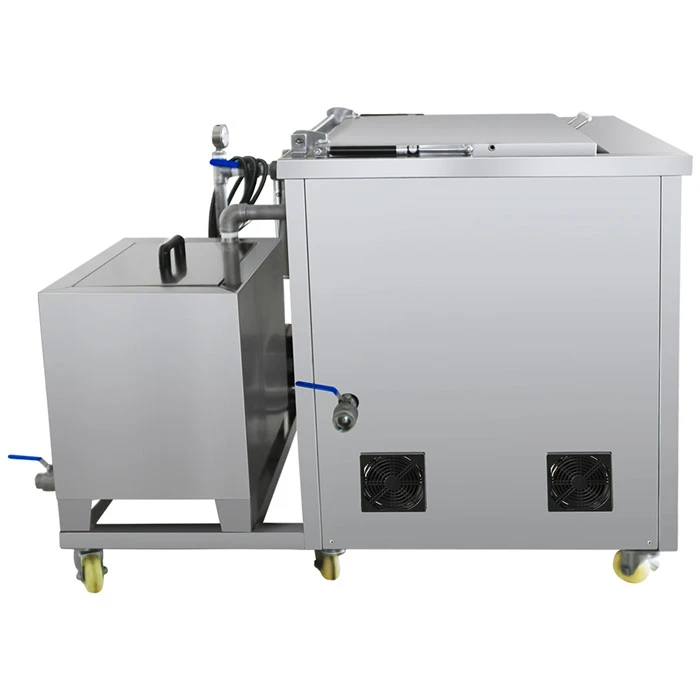
What causes an alarm or fault in the ultrasonic generator of an industrial ultrasonic cleaner?
Sep 16, 2026
1. Overcurrent / Overload Alarm
• Transducer failure: transducer debonding, piezoelectric ceramic cracking, insulation degradation, short circuit in a single transducer, impedance anomaly, or current surge
• Cable / Aviation connector: water ingress at connections, short circuit due to damaged insulation, or oxidized/loose connectors
• Low liquid level or dry start (starting without liquid is strictly prohibited; it easily burns out transducers and triggers overcurrent protection)
• Cleaning fluid conductivity too high (due to salts or metal ions) or tank leakage
• Generator power component aging (MOS/IGBT failure, rectifier bridge breakdown)
• Input voltage fluctuations or voltage levels too low/high
2. Overheat Alarm (Overtemperature Protection)
• Cooling fan failure, blocked airflow, or heat sinks clogged with oil/dust
• Prolonged continuous operation at full power causing excessive component temperature rise
• Equipment placed too close to a wall (poor ventilation) or ambient temperature >40°C
• Sustained load overload causing continuous heating of power transistors
3. Frequency Unlock / Frequency Tracking Failure Alarm
• Transducer aging causing resonant frequency drift; loose transducers or ceramic cracks
• Frequency mismatch between transducer and generator (e.g., connecting a 40kHz transducer to a 28kHz generator)
• Connection cables too long or poorly shielded, causing abnormal signal feedback
• Aging of matching inductors/capacitors or detuning of the matching circuit
• Drastic changes in water temperature causing transducer frequency shift
4. Liquid Level / Water Level Alarm (Triggered by External Signal)
• Float level switch stuck or coated with oily sludge/scale
• Scaling on level electrodes causing false "low water" alarms; actual level too low (below transducer height)
• Level signal wire broken or short-circuited
5. Leakage / Grounding Anomaly Alarm
• Transducer insulation failure causing leakage to the tank body
• Cleaning fluid seeping into the transducer backplate or water ingress in the junction box
• Poor equipment grounding connection; interference from high-voltage workshop equipment
6.Power-related alarms (phase loss, overvoltage, blown fuse)
- Phase loss or loose neutral wire (three-phase models)
- Input voltage surge or unstable power grid
- Blown internal fuse (usually indicates a downstream short circuit, such as a shorted transducer or a failed power transistor)
Quick troubleshooting sequence
1. Power off, disconnect the output cable between the generator and the transducer, and power up the generator alone to test
◦ If the alarm clears: The fault lies with the transducer, aviation connector, or tank assembly
◦ If the alarm persists: The generator motherboard or power components are damaged
2. Check the liquid level; ensure the liquid in the tank fully covers the transducers; do not operate without load
3. Visually inspect the aviation connector and cables for water ingress, damage, or oxidation
4. Check if the generator fan is spinning and clean dust from the cooling vents
5. Measure the transducer insulation resistance using a megohmmeter; inspect individual transducers for debonding or cracks
6. Verify the input voltage; keep the unit away from equipment causing strong interference, such as variable frequency drives (VFDs) or welding machines