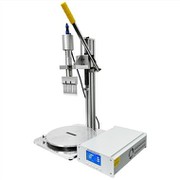
What are the working principles and applications of ultrasonic plastic welding machine?
Feb 16, 2022
Ultrasonic plastic welding machine in the welding of plastic products, neither add any adhesive, filler or solvent, nor consume a lot of heat, has the advantages of simple operation, fast welding speed, high welding strength, high production efficiency. Therefore, ultrasonic welding technology is more and more widely used.
Working principle of ultrasonic plastic welding machine
When the ultrasonic action on the thermoplastic plastic contact surface, will produce tens of thousands of high-frequency vibration per second, this high frequency vibration to a certain amplitude, through the welding parts of the ultrasonic energy transmission to the welding area, because the welding area is two welding interface at the sound resistance, so will produce local high temperature. And because of the poor thermal conductivity of plastic, it can not be timely distributed, gathered in the welding area, resulting in the rapid melting of the two plastic contact surface, plus a certain pressure, so that the fusion into one. When the ultrasonic wave stops, let the pressure continue for a few seconds, so that it solidifies, so that a strong molecular chain is formed, to achieve the purpose of welding, welding strength can be close to the strength of the raw material. The quality of ultrasonic plastic welding depends on the amplitude of the transducer welding head, the pressure and welding time, welding time and welding head pressure can be adjusted, the amplitude is determined by the transducer and the horn. There is an appropriate value for the interaction of these three quantities. When the energy exceeds the appropriate value, the melting amount of plastic is large and the welding is easy to deform. If the energy is small, it is not easy to weld, and the pressure added can not be too large. The optimum pressure is the product of the edge length of the welding part and the optimum pressure per 1mm of the edge.