


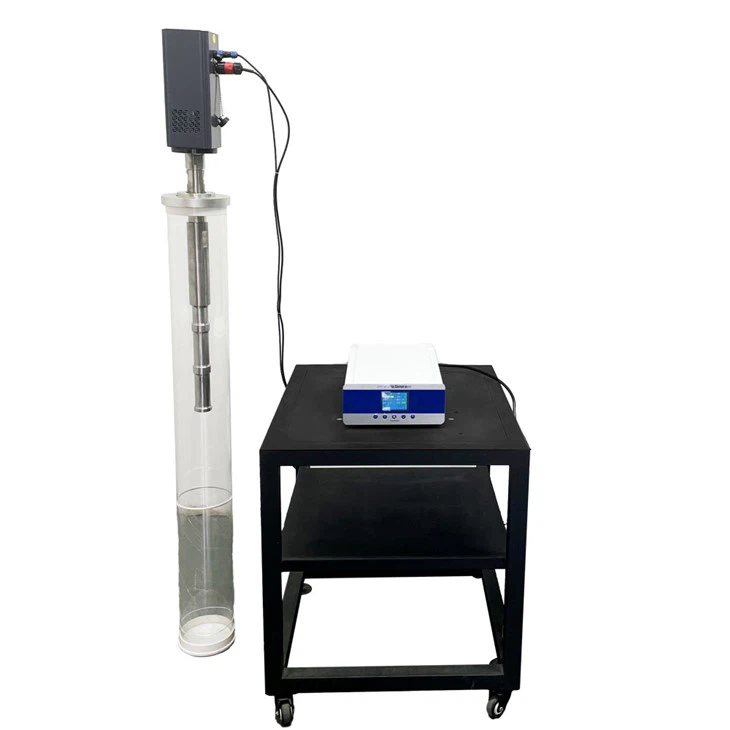

Ultrasonic Liquid Processing
There are many applications in ultrasonic liquids, such as homogenization, cell division, sonochemistry, degassing or extraction, etc.
The ultrasonic liquid processing system is an efficient, environmentally friendly, and energy-saving liquid treatment equipment. This system can quickly achieve liquid mixing, emulsification, pulverization, and other processing effects through high-frequency ultrasonic vibration, improving the uniformity and stability of the product. At the same time, our ultrasonic system is easy to operate and has low maintenance costs. It is an ideal choice for pharmaceutical, chemical, environmental protection, food, and other industries.
Jiayuanda ultrasonic liquid processing generators can be used for laboratory samples, pilot-scale processing, or large-scale production. This includes ultrasonic processors and probes for sonicating any liquid volume, from a few microliters to hundreds of cubic meters per hour.
Four main components of Ultrasonic Liquid Processing
The ultrasonic liquid handler consists of four main components: ultrasonic generator, ultrasonic transducer, tool head, and reaction chamber.
- Ultrasonic generator
The ultrasonic generator is the brain and heart of the ultrasonic liquid processor. It converts 110 V or 240 V AC line power into a signal with a frequency close to 20 kHz that drives a piezoelectric transducer. Use automatic frequency tracking and adjustment to ensure optimal resonance operation. The generator can output any electrical power up to its rated value. Power is automatically adjusted based on acoustic loading conditions (e.g., ultrasonic amplitude setting, liquid viscosity and pressure, tool head immersion depth, etc.).
- Piezoelectric transducer
An ultrasonic transducer (also known as an "ultrasonic converter" and a "piezoelectric transducer") is an electromechanical component that converts electrical energy from an ultrasonic generator into mechanical energy in the form of ultrasonic vibrations with a maximum amplitude of approximately 20- 25 microns. These mechanical vibrations are then transmitted to the tool head where they are amplified and delivered into the treated fluid.
- Tool head
The tool head (also called ultrasonic horn, or ultrasonic probe) is the component that amplifies the amplitude of ultrasonic vibrations from the transducer and transmits them to the liquid being sonicated. Traditional ultrasonic processors use tool heads that can only deliver high ultrasonic amplitudes when their output tip diameter is small, making them suitable for laboratory research but not suitable for industrial-scale applications. Process scale-up requires switching to tool heads with larger output tip diameters capable of outputting ultrasonic energy into large volumes of working fluid while still maintaining high amplitude. The tool head is designed to do just that.
Products Specification:
| Model | Ultrasonic frequency | Ultrasonic power | Standard tool head 1/1 | Ultrasonic generator model | Ultrasonic transducer model | Dispersed capacity | duty cycle | Protective function |
| CQ28-P800 | 28KHZ±1KHZ | ≤500W | T28-D10L135 | 2900SP-CQ | JYD-3828-4P8-AU | ≤6L | 10%-100% | Over temperature/over power overtime/overload |
| CQ28-P1200 | 20KHZ±0.5KHZ | ≤600W | T28-D20L187 | 2900SP-CQ | JYD-5020-6P4-AU | ≤10L | 10%-100% | Over temperature/over power overtime/overload |
| CQ20-P2000 | 20KHZ±0.5KHZ | ≤1200W | T20-D30L490 | 2900SP-CQ | JYD-5020-4P4-AU | ≤30L | 10%-100% | Over temperature/over power overtime/overload |
| CQ20-P2600 | 20KHZ±0.5KHZ | ≤2000W | T20-D30L490 | 2900SP-CQ | JYD-5020-6P4-AU | ≤50L | 10%-100% | Over temperature/over power overtime/overload |

Main features
- Efficient processing: The high-frequency vibration of ultrasonic waves can quickly transfer energy to the liquid to achieve rapid mixing, emulsification, and crushing processing effects. Compared with traditional mechanical stirring or heat treatment, ultrasonic liquid processing is more efficient and greatly shortens the treatment time.
- Uniform treatment: Ultrasonic waves can produce a uniform sound field distribution in the liquid, ensuring that all parts of the liquid can be treated evenly. This helps eliminate temperature, concentration, and composition gradients in the liquid, improving product uniformity and stability.
- Environmental protection and energy saving: Ultrasonic processors do not require the addition of any chemical reagents or additional heating or cooling equipment, making it a very environmentally friendly treatment method. At the same time, the ultrasonic processor has low energy loss and high energy utilization, which is beneficial for reducing energy consumption and operating costs.
- Easy operation and maintenance: The ultrasonic liquid treatment system adopts a humanized design and is simple and convenient to operate. At the same time, the equipment has a compact and durable structure, low maintenance costs, and can operate stably for a long time.
- Wide scope of application: Ultrasonic liquid processing system is suitable for the treatment of various liquids such as chemical solutions, biological samples, food raw materials, etc., in the fields of medicine, chemical industry, environmental protection, food, etc.
Working principle of Ultrasonic Liquid Processing
Ultrasonic Water Treatment For many industries, controlling the growth of bacteria and algae in water is a highly relevant upstream or downstream process in the production process. It is well known that powerful ultrasound can have an impact on cellular structures, leading to cell lysis and cell death, and can clean through mechanical impact. Additionally, biofilm, residue, and debris can be successfully removed from tanks, buckets, containers, and even filters with just one very simple but effective sonication step. The mechanical vibration and cavitation shear force generated by ultrasonic waves can remove contaminants. Generally, no detergent is required and the removed residue can be easily rinsed away.


Send Inquiry
