


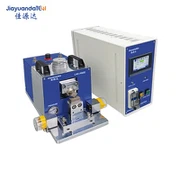
Ultrasonic Metal Bonding Machine
The working principle of this Ultrasonic Metal Bonding Machine is to transmit high-frequency vibration waves on two metal surfaces that need to be welded, and then generate a certain amount of pressure, causing friction and fusion of two molecular layers on the surfaces of the two metals....
Ultrasonic Metal Bonding Machine is a type of metal welding machine that takes a very short time to weld and requires relatively low pressure. Its working principle is to transmit high-frequency vibration waves on the surfaces of two metals that need to be welded, and then generate a certain amount of pressure. Under such pressure, the surfaces of the two metals will generate a certain amount of friction, and then fuse the two molecular layers.
Ultrasonic metal welding machine has certain advantages. It can quickly complete work tasks when in use, with very low energy consumption, high fusion strength, and strong conductivity. Therefore, there is no need to consider resistance too much, and there are not too many requirements for the surface of the welded metal. Whether it is oxidation or electroplating, it can be operated. When welding, the time required is very short, and there is no need to use any auxiliary items during operation, which reduces the cost and time of welding. There is no spark during work, and it can even be compared to cold processing.
And it also has some drawbacks, such as the limited number of metal parts it can weld. If it is too thick, it cannot be operated. When welding, the position should not be too large, otherwise it will affect the welding effect. Moreover, during the welding process, pressure needs to be applied to complete it.
The application range of ultrasonic metal welding machine is very broad, and it can greatly demonstrate its skills in welding many items, such as when fusing aluminum foil and aluminum sheets, fusing some wires, fusing wires with other electronic devices, fusing different types of metal sheets, fusing heat dissipation seats of various household appliances and large instruments, and fusing metal pipe seals, etc.
Parameters
| Product number | LD20-P4500 | LD20-P4500B | LD20-P6000 | LD20-P8000 |
| Power supply | Three phase voltage AC380V | |||
| Air supply Compressed air | 0.1-0.6MPa | |||
| Transducer | Single transducer | |||
| Usage environment | Temperature 25 ± 5% humidity 30-90 | |||
| Ultrasonic peak power | 4500W | 4500W | 6000W | 8000W |
| Maximum power of the machine | 5000W | 5000W | 7000W | 9000W |
| Ultrasonic frequency | 20KHz | 20KHz | 20KHz | 20KHz |
| Maximum ultrasound time | 10S | 10S | 10S | 10S |
| Adjustable accuracy of ultrasound time | 0.01S | 0.01S | 0.01S | 0.01S |
| Ultrasonic mold connection thread size | 1/2*20UNF | 1/2*20UNF | 1/2*20UNF | 1/2*20UNF |
| Weldable copper and aluminum wire sizes | 6~35mm² | 6~35mm² | 16~50mm² | 25~70mm² |

FAQ:
How to solve the frequency deviation alarm of an Ultrasonic Metal Bonding Machine?
1. During operation, there may be a certain amount of heating phenomenon in the hot welding head, which is caused by the mechanical loss of the material itself and the heat conduction of the welded part. The standard for judging whether the heating of the welding head is normal is to emit ultrasonic waves continuously for more than half an hour without load (i.e. without contact with the workpiece), and the temperature should not exceed 50-70 ℃. If the heating is damaged, it indicates that the welding head is damaged or the material is unqualified and needs to be replaced.
2. When the welding head is working, the following reasons should be analyzed:
① Is the installation screw loose
② Is there any crack on the welding head
③ Is the welding head in contact with objects that should not be in contact?
3. When the generator emits an overload alarm, the following steps should be followed for inspection:
① During the no-load test, if the working current is normal, it may be due to the welding head coming into contact with objects that should not be in contact or a malfunction in the parameter adjustment between the welding head and the welding base.
② When the no-load test is abnormal, the first thing to observe is whether there are cracks in the welding head and whether the installation is firm. Then, remove the welding head and perform the no-load test again to rule out whether there is a problem with the transducer and amplitude lever, and step by step solve the problem. After ruling out the possibility of a malfunction in the transducer and amplitude lever, replace the new welding head to determine.
③ Sometimes, there may be situations where the no-load test is normal but cannot work properly, which may be due to internal changes in sound energy components such as welding heads, resulting in poor sound energy transmission. Here is a relatively simple method of judgment: hand-hand-touch method.
When working normally on the surface of a welding head or amplitude lever, the amplitude is very uniform and feels smooth like velvet to the touch. When sound energy is not transmitted smoothly, there may be bubbles or burrs when touched by the hand. In this case, the elimination method should be used to eliminate the problematic components. When the generator is abnormal, the same situation can also occur because normally, when detecting the input waveform of the transducer, it should be a smooth sine wave. This phenomenon can also occur when there are spikes or abnormal waveforms on the sine wave. In this case, another whole acoustic component can be replaced to distinguish.
So, based on what you said, it may be due to a loose screw or overload somewhere.



Send Inquiry
