


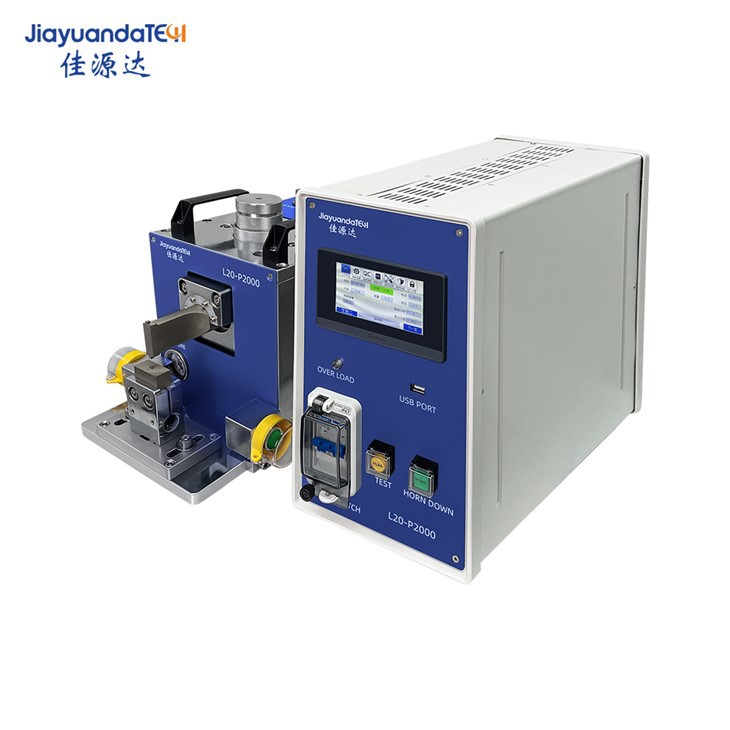


Ultrasonic Electrode Welder
The Ultrasonic Electrode Welder uses pressure welding to apply appropriate pressure to the upper sonotrode to effectively transmit the generated sound waves to the welded joint surface, causing high-speed friction on the surface of the metal atoms, and the instantaneous high temperature generated by the high-speed friction of the joint Achieve welding effect, intelligent control mode, convenient operation, safe and reliable, strong power output and stable performance.
Ultrasonic welding of battery electrode ears is an efficient, reliable, and environmentally friendly battery manufacturing process. The battery electrode ear is a key component connecting the battery to external circuits, and its welding quality directly affects the performance and safety of the battery. Ultrasonic welding technology utilizes the energy generated by ultrasonic vibration to form a strong welding connection between the battery electrode ears and the battery body through instantaneous high pressure and frictional heat.
The process of Ultrasonic Electrode Welder usually includes the following steps:
Preparation stage: Firstly, it is necessary to ensure that the surface of the battery body and electrode ears is clean, free of oil and impurities, to ensure welding quality. Meanwhile, select appropriate ultrasonic welding equipment and corresponding welding parameters, such as welding time, amplitude, and pressure.
Positioning and alignment: Accurately place the electrode ears in the predetermined position of the battery body and perform alignment operations to ensure that the welding surface between the electrode ears and the battery body is tightly adhered without gaps.
Ultrasonic welding: Start the ultrasonic welding equipment and transfer ultrasonic energy to the contact surface between the electrode ear and the battery body through the ultrasonic vibration head. Under the action of ultrasound, the contact surface generates frictional heat and instantaneous high pressure, causing the material to quickly melt and form a welded connection.
Cooling and Curing: After welding is completed, the welding area needs to be cooled and cured to ensure the stability and reliability of the welding connection.
Parameters
| Product model | L40-P800 | L20-P2000 | L20-P4500 |
| Power supply | Single phase AC220V/AC110V switchable 50Hz | Single phase AC220V/AC110V switchable 50Hz | Single phase AC220V/AC110V switchable 50Hz |
| Air supply | Compressed air 0.1-0.6MPa | Compressed air 0.1-0.6MPa | Compressed air 0.1-0.6MPa |
| Ultrasonic peak power(W) | 800 | 2000 | 4500 |
| Maximum power of the machine(W) | 1000 | 2000 | 4500 |
| Ultrasonic frequency(KHz) | 40 | 20 | 20 |
| Maximum ultrasound time(s) | 0.4s | 0.4s | 0.4s |
| Adjustable accuracy of ultrasound time(s) | 0.01s | 0.01s | 0.01s |
| Ultrasonic mold connection thread size | M8*1.25 | 1/2*UNF | 1/2*20UNF |
| Data output | Can export each welding data from an external USB drive | Can export each welding data from an external USB drive | Can export each welding data from an external USB drive |
| Upper mold size(mm) | 4×4 | 4×4 8×4 | 12×4 8×4 |
| Bottom mold size | 20×20 quick disassemble and replaceable | 20×20 quick disassemble and replaceable | 20×20 quick disassemble and replaceable |
| Maximum number of welding layers | 20 layers of copper foil (negative electrode) 20 layers of aluminum foil (positive electrode) | 30 layers of copper foil (negative electrode) 30 layers of aluminum foil (positive electrode) | 60 layers of copper foil (negative electrode) 60 layers of aluminum foil (positive electrode) |

Advantages of Ultrasonic Electrode Welder:
* Low requirements on the welding metal surface, no need to scrape off the oxide layer or electroplating layer;
* Easy to install, easy to operate, simple to maintain;
* High welding efficiency and quality;
* The welding material does not need to be melted, and the material characteristics are not changed;
* Circuit protection device;
* Good conductivity after welding, with extremely low or almost zero resistivity;
* Quality control system and automatic monitoring;
* It can realize welding of different non-ferrous metal materials;
* Integration of automation systems;
* Strong stability, the mold has an extremely long service life;
FAQ
Q: What factors should be noted when ultrasonic welding battery electrode ears?
Answer: When ultrasonic welding battery electrode ears, the following factors need to be noted:
Material selection: Ensure that the materials of the battery body and electrode ears match to achieve the best welding effect.
Welding parameters: Reasonable selection of welding time, amplitude, and pressure parameters based on material type and thickness to ensure welding quality and stability.
Surface preparation: Ensure that the surface of the welding area is clean, free of oil and impurities, to improve the quality and reliability of the welded joint.
Equipment maintenance: Regularly inspect and maintain Ultrasonic Electrode Welder to ensure that it is in good working condition and avoid malfunctions and safety hazards.
Q: How to detect welding quality after ultrasonic welding of battery electrode ears?
Answer: After ultrasonic welding of battery electrode ears, the welding quality can be detected through the following methods:
Appearance inspection: Observe the appearance of the welded joint and check for defects such as cracks, pores, and lack of fusion.
Tensile testing: Conduct tensile testing on welded joints to evaluate their strength and reliability.
Conductivity test: Evaluate the conductivity of a welded joint by measuring its resistance value.
Sealing test: Conduct sealing test on welded joints to ensure they have good sealing performance and prevent internal short circuits and leaks in the battery.
These detection methods can help us promptly identify and solve potential welding quality issues, ensuring the safety and reliability of batteries.
For more details of Ultrasonic Electrode Welder, please feel free to contact us!!!


Send Inquiry
