


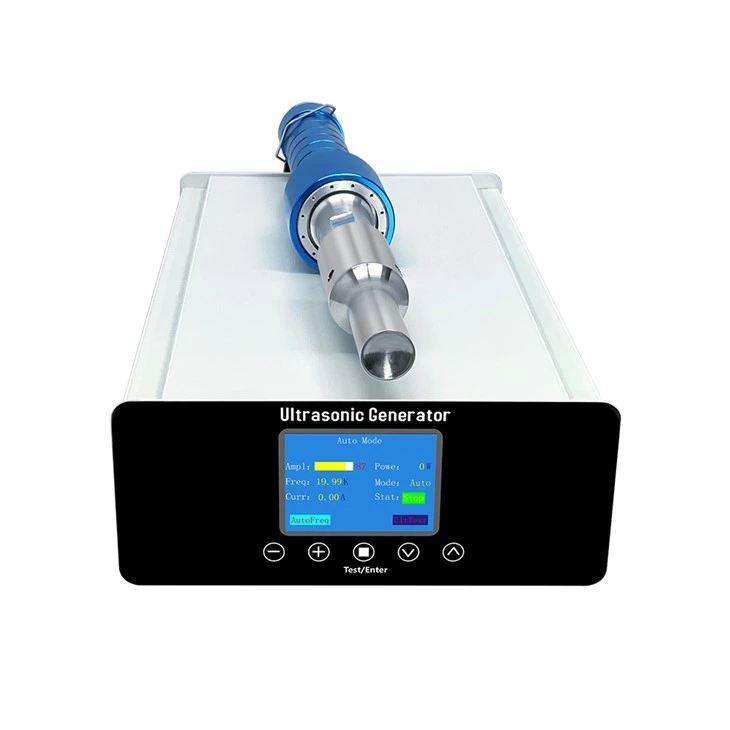


Handheld Ultrasonic Welder
1. Lightweight handheld design, ergonomic grip for long-hour operation;
2. Flexible mobile welding for large, irregular & curved plastic parts;
3. Fast spot welding within 1 second, no preheating & cooling;
4. Strong, seamless weld without glue, rivets or adhesives;
Product Description:
A handheld ultrasonic welder consists of several basic components: a high-frequency current converter (ultrasonic generator), a piezoelectric converter, an amplitude modulator (booster), an electrode arm or acoustic horn (ultrasonic transducer/welding tip), and a housing (straight-grip or pistol-grip style). The high-frequency current converter primarily transforms input low-frequency current into output high-frequency current matching the ultrasonic frequency range; an output frequency of 28 kHz is commonly used for ultrasonic welding. The piezoelectric converter transforms electrical energy into mechanical vibrational energy while maintaining the same frequency. This function is typically performed by a piezoelectric element or transducer utilizing asymmetric crystals-such as natural quartz wafers or synthetic lithium titanate or barium titanate wafers-which undergo mechanical deformation or dimensional contraction at the same frequency as the alternating electric field applied to them; this phenomenon is known as the piezoelectric effect. By leveraging this effect, high-frequency electrical energy is converted into ultrasonic energy. The amplitude modulator, a half-wave resonator made of aluminum or titanium, serves to increase the amplitude of the vibration. The electrode arm or acoustic horn-also known as the ultrasonic tool or mold-is the component that transfers energy to the plastic product being welded; it is typically fabricated from alloys such as aluminum or titanium. Its function is to transmit high-frequency vibration and pressure to the welding site of the component, with the amplitude being amplified at the tip of the tool.
The operating principle of the handheld ultrasonic welder involves using an ultrasonic generator to convert 50/60 Hz current into high-frequency alternating current. This electrical energy is fed into the ultrasonic transducer, generating mechanical motion at the same frequency. This mechanical motion is transmitted through the amplitude modulator to the ultrasonic welding tip, which delivers the vibrational energy to the interface of the workpieces to be welded. In this zone, the energy is converted into heat through friction, melting the plastic. Brief pressure maintained on the workpieces after the vibration ceases allows the two parts to fuse together through molecular bonding; the welding process typically takes less than one second, resulting in a weld strength comparable to that of the base material. Additionally, a handheld ultrasonic welding machine can amplify high-frequency vibration waves using a booster and transmit them to the upper mold; the mold then applies these amplified waves to the workpiece, generating intense, localized heat through rapid high-frequency vibration at the interface, thereby fusing the parts together.
Parameter of Handheld Ultrasonic Welder:
| Model | Ultrasonic frequency | Ultrasonic power | Ultrasonic generator | Ultrasonic transducer | Ultrasonic horn | Package size | Package weight |
| W10 | 28KHZ±1KHZ | 2900SP-W | ≤300W | JYD-2528-4P8-ARF | ∅10 | 540X340X290 | 8.5KG |
| W20 | 30KHZ±1KHZ | 2900SP-W | ≤1000W | JYD-3030-4P8-TMUK | ∅10 | 540X340X290 | 8.6KG |
| 35KHZ±1KHZ | 2900SP-W | ≤1000W | JYD-3035-4P8-TMUF | ∅10 | 540X340X290 | 8.6KG | |
| 40KHZ±1KHZ | 2900SP-W | ≤1000W | JYD-3040-4P8-TMUF | ∅10 | 540X340X290 | 8.6KG | |
| W20S | 30KHZ±1KHZ | 2900SP-W | ≤1000W | JYD-3030-4P8-TMUK | ∅10 | 540X340X290 | 8.7KG |
| 35KHZ±1KHZ | 2900SP-W | ≤1000W | JYD-3035-4P8-TMUF | ∅10 | 540X340X290 | 8.7KG | |
| 40KHZ±1KHZ | 2900SP-W | ≤1000W | JYD-3040-4P8-TMUF | ∅10 | 540X340X290 | 8.7KG | |
| W30 | 20KHZ±1KHZ | 2900SP-W | ≤1500W | JYD-3820-4P8-AMUK | ∅20 | 540X340X290 | 8.8KG |
| 28KHZ±1KHZ | 2900SP | ≤1500W | JYD-3828-4P8-AQ | ∅20 | 540X340X290 | 8.8KG |
Feature of Handheld Ultrasonic Welder:
1.Lightweight design with ergonomic handle reduces fatigue during prolonged operation; supports one-handed use without a fixed workstation.
2.Not limited by workpiece size or mold placement; weldable on large, irregular, curved, and corner workpieces, overcoming the limitations of benchtop machines.
3.Long cable connection between the main unit and welding handle enables on-site operation at production lines, warehouses, or semi-finished goods areas; easy to disassemble and transport.
4.Instant welding with 0.1–1 second per spot; no preheating or cooling required, significantly improving assembly line efficiency.
5.Ultrasonic molecular fusion eliminates the need for glue, screws, or auxiliaries; produces smooth, burr-free, non-discolored seams with high seal integrity and tensile strength.
6.Automatic frequency tracking with replaceable welding tips; self-calibrates during extended use to prevent overload, resonance failure, or tip burnout.

Application:
It is mainly used for welding thermoplastic materials, such as plastics, rigid thermoplastics, and the insertion and edge pressing processes between metal and plastic parts. It has widely replaced traditional organic solvent-based adhesive processes and is applied in multiple fields including electronics and electrical appliances, automotive parts, apparel packaging, textiles, environmental protection, medical devices, toys, and communication equipment. For example, handheld ultrasonic welder can be used in the production of plastic toys, water guns, aquarium game machines, children's dolls, plastic gifts, cassette tape cases and reels, disk shells, mobile phone battery cases, rectifier transformers, household appliances (such as electronic clocks, hair dryers, steam iron water tanks, electric kettle air bags, computers, etc.), stationery and daily necessities (such as pencil cases, document folders, pen holders, cosmetic cases, etc.), and automotive and motorcycle parts (such as batteries, headlights, instruments, car door panels, bumpers, etc.).
FAQ:
What materials can this handheld ultrasonic welder weld?
It works for all thermoplastics: ABS, PP, PE, PC, PA/Nylon, PBT; non-woven fabric, filter cloth, plastic riveting, film lamination. It cannot weld non-thermoplastics like silicone, PTFE, glass, pure metal, hard rubber. One layer of the workpiece must be thermoplastic to form fusion.
Can I weld curved, large, irregular plastic parts?
Yes, handheld gun with long cable, free movement. Unlike desktop fixed welder, no limit on workpiece size or shape, ideal for big bumpers, interior trims, oversized semi-finished goods.
What voltage does the handheld ultrasonic welder support for my country? 110V/220V dual voltage?
Standard 220V 50Hz; dual voltage 110/220V 50/60Hz customized for US, Canada, Europe, Southeast Asia. We can adjust plug type (US/EU/UK/AU) free of charge.
Is auto frequency tracking built-in? What protection functions does it have?
Full digital auto frequency chasing system, stable under long continuous work. Overheat, overcurrent, overload, abnormal frequency auto alarm & shutdown to protect transducer and generator.
Can you customize welding horn/sonotrode for my products? How long is the lead time?
Yes, custom aluminum/titanium horns according to your product drawing or sample. Standard horn 5–7 days, complex shaped horn 15–20 days.
For more details of Handheld Ultrasonic Welder, please feel free to contact us !


Send Inquiry
