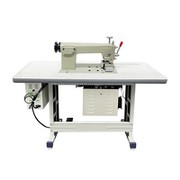
Step-by-Step Adjustment for Ultrasonic Lace Sewing Machine
Jun 24, 2026
Step1: Pre-operation Preparation
1. Connect clean dry air compressor and matched power supply (110V/220V), ground the machine well.
2. Install embossing roller tightly, check titanium welding horn without crack or loose screw.
3. Test left foot pedal to lift/lower roller smoothly, no stuck noise.
Step2:Ultrasonic Frequency Resonance Adjustment (Core Step)
Keep roller lifted without touching horn, no load:
1. Power on generator, press sound test button within 3 seconds each time.
2. Rotate frequency knob to make amplitude meter below 50, idle current 0.4–0.6A.
3. Lock the knob after tuning. Overload alarm means wrong frequency or damaged transducer.
Step3:Air Pressure Adjustment (2–5 kg/cm²)
• Thin non-woven, mask edge sealing: 2.0–2.8 kg/cm²
• Thick SMS surgical gown, multi-layer film, deep embossing: 3.2–5.0 kg/cm²
Too low pressure = weak welding; too high pressure = fabric melt through.
Step4:Roller Parallel Calibration
1. Put A4 paper between roller and horn, run one full circle at low speed.
2. If imprint uneven, loosen eccentric wheel screw to adjust roller balance.
3. Lock all screws after uniform imprint. Adjust cylinder limit to avoid hard collision.
Step5:Power & Feeding Speed Matching
1. Power level 1–5:
Thin fabric: Level 2–3; Thick multi-layer medical cloth: Level 4–5
2. Feeding speed:
Medical mask & precise sealing: low speed; Non-woven bag & bed sheet: medium-high speed
Rule: Higher speed needs higher pressure & power for stable bonding.
Step6:Sample Test Fine Tuning
Easy to tear apart: increase pressure / power, reduce speed
Fabric burnt & black edge: lower power & pressure, speed up feeding
Uneven embossing: re-calibrate roller parallelism
Frayed unsealed edge: slightly raise power, slow down roller speed