


Ultrasonic Belt Cutting System
Through 20KHZ high-speed vibration and friction, the cutting surface reaches a high temperature, and after the cutting is completed, it returns to a low temperature, so the ultrasonic wave overcomes the sticking, blackening, smelly, and coke in the traditional eager cutting process during the...
The ultrasonic belt cutting system mainly utilizes ultrasonic technology to achieve fast and accurate cutting of ribbons. The system mainly consists of ultrasonic generators, transducers, cutting knives, and other parts. The ultrasonic generator generates high-frequency electrical signals, which are converted into high-frequency mechanical vibrations through transducers and transmitted to the cutting blade. Under high-frequency vibration, the cutting blade comes into contact with the ribbon and generates friction, causing the ribbon to quickly melt in a very short time, thus achieving cutting. It has the advantages of fast cutting speed, smooth and beautiful incisions, no need for preheating, no blackening, and no scorching. At the same time, the system can also perform automated control as needed, achieving continuous cutting and automated production.
Product features of Ultrasonic Belt Cutting System
1 It is adopted, with complete and beautiful incision, neat and smooth cutting edge, no burr, no loose edge, no black incision, and good effect.
2. The machine adopts the Chinese control system for automatic feeding, which is fast, easy, fast and efficient to adjust the length, and can cut multiple pieces at the same time
3. It can cut round, elliptical, square, rectangular, single hole, multi hole, mixed hole and irregular hole shapes.
4. The punching and shearing of the webbing shall be completed at one time: ultrasonic tape cutting and punching, automatic sealing, no burr, no blackening, no stinking, smooth and round, no loose edges.
Specification of Ultrasonic Belt Cutting System
| Model | Frequency | Power | Voltage | Horn size | Cutting speed(max) | Net weight | Gross weight |
| S20-L90W18 | 20KHz | 2000W | 220V 50/60Hz | 90mm×18mm | 60-100times/min | 13.63kg | 14.43kg |
| S20-L78W20 | 20KHz | 2000W | 78mm×17mm | 80-100times/min | 11.70kg | 12.50kg | |
| S30-L33W16 | 30KHz | 1600W | 33mm×16mm | 80-100times/min | 7.60kg | 8.40kg | |
| S35-L32W10 | 35KHz | 1200W | 32mm×10mm | 80-100times/min | 7.40kg | 8.20kg |
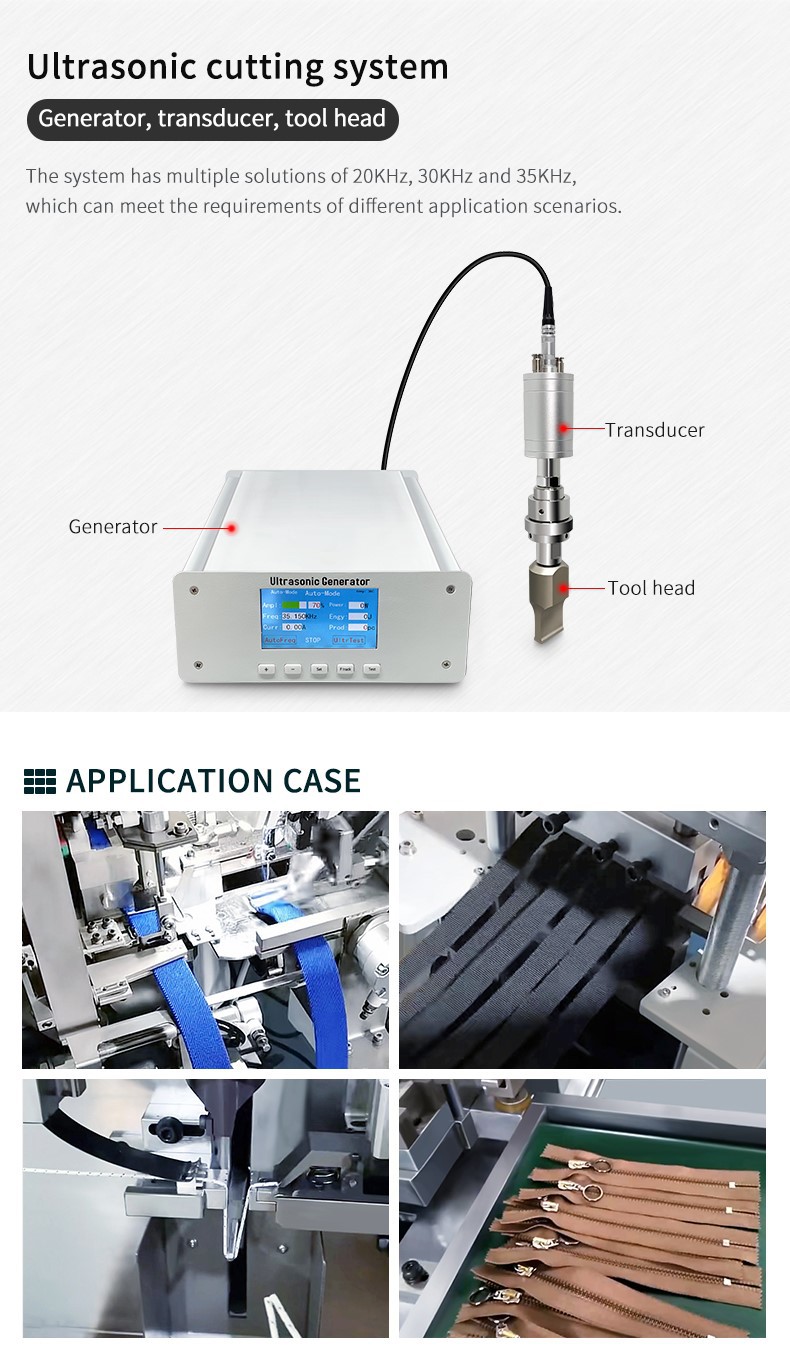
Applications of Ultrasonic Belt Cutting System
Mainly applicable industries: It is widely used in clothing industry, shoe making and hat making industry, luggage manufacturing industry, craft decoration industry, packaging industry and so on. Applicable materials: cutting of ribbons such as ribbons, cloth belts, Velcro, ropes, ribbons, satin ribbons, and colored ribbons.
FAQ:
What are the conventional ultrasonic processes in the textile industry?
1. Ultrasonic cutting
Ultrasonic cutting can form smooth, neat, and long-lasting edges without causing discoloration of textiles. Ultrasonic waves can simultaneously cut and sew edges, which prevents the formation of thread detachment in knitted or textile materials. At the same time, there is a taper at the seam edge to avoid pilling. The applications of ultrasonic cutting include products such as decorative strips, clothing labels, cutting carpets, industrial woven tapes, and diagonal cutting.
2. Ultrasonic heat sealing
This process can be used for applications that form continuous seams, such as producing protective clothing and blinds, or for processing immersion welding such as button eyes, collar braces, and tie ups. Single machine "sewing" equipment or standard ultrasonic welding machines can also achieve this process.
3. Rotary welding
Application of ultrasonic rotary drum for bonding and laminating of multiple wide mesh textile or non textile synthetic fiber materials. This process involves placing multi-layer fiber materials in a rotating printing cylinder and a row of welding heads to form a sufficiently wide mesh pattern. This method does not require the use of any chemical adhesives or other auxiliary materials, and can be processed into unique fabrics that cannot be achieved by other bonding methods. For example, bedspreads, mattresses, disposable medical supplies, etc. can all be processed using this technology method.


Send Inquiry
