


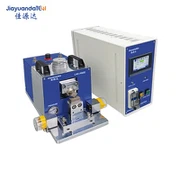
Ultrasonic Wire Welding Machine
According to the requirements of the lithium battery electrode welding process, a mechanical structure based on piezoelectric ceramic longitudinal vibration is proposed, and a fully digitally controlled Ultrasonic wire welding machine power system is designed.
With its outstanding advantages of energy saving, environmental protection and convenient operation, ultrasonic wire welding machine has attracted more and more attention. Ultrasonic metal welding has been widely used in many fields.
Parameters:
| Product model | L40-P800 | L20-P2000 | L20-P4500 |
| Power supply | Single phase AC220V/AC110V switchable 50Hz | Single phase AC220V/AC110V switchable 50Hz | Single phase AC220V/AC110V switchable 50Hz |
| Air supply | Compressed air 0.5-0.8MPa | Compressed air 0.5-0.8MPa | Compressed air 0.5-0.8MPa |
| Ultrasonic peak power(W) | 500 | 1200 | 2600 |
| Maximum power of the machine(W) | 600 | 1500 | 2800 |
| Ultrasonic frequency(KHz) | 40 | 20 | 20 |
| Maximum ultrasound time(s) | 0.4s | 0.4s | 0.4s |
| Adjustable accuracy of ultrasound time(s) | 0.01s | 0.01s | 0.01s |
| Ultrasonic mold connection thread size | M8*1.25 | 1/2*20UNF | 1/2*20UNF |
| Data output | Can export each welding data from an external USB drive | Can export each welding data from an external USB drive | Can export each welding data from an external USB drive |
| Upper mold size(mm) | 4×4 | 4×4 8×4 | 12×4 8×4 |
| Bottom mold size | 20×20 quick disassemble and replaceable | 20×20 quick disassemble and replaceable | 20×20 quick disassemble and replaceable |
| Maximum number of welding layers | 20 layers of copper foil (negative electrode) 20 layers of aluminum foil (positive electrode) | 30 layers of copper foil (negative electrode) 30 layers of aluminum foil (positive electrode) | 60 layers of copper foil (negative electrode) 60 layers of aluminum foil (positive electrode) |
Application:
It is applicable to the instantaneous welding of copper, aluminum, tin, nickel, gold, silver, molybdenum, stainless steel and other non-ferrous metal materials, such as thin plates, thin rods, wires, sheets and strips, with a total thickness of 2-4mm.
Factors affecting Ultrasonic Wire Welding Machine effect:
1. Welding power, which depends on the thickness of the weldment and the hardness of the material. Generally speaking, the power increases with the increase of the thickness and hardness of the weldment.
2. Vibration frequency, which includes the value of resonance frequency and the accuracy of vibration frequency. The selection of frequency is mainly based on the thickness and physical properties of weldments, and is generally controlled at 15 ~ 75khz. In general, the thinner the weldment, the higher the frequency. Amplitude, whose size is determined by the thickness and material of the weldment, and its size range is 5 ~ 25 μ m. With the increase of the thickness and hardness of the weldment, the amplitude increases correspondingly.
3. Static pressure depends on the thickness, hardness, joint form and ultrasonic power of the material. It will be directly used to transmit ultrasonic vibration energy to the weldment.
4. The welding time depends on the thickness and material properties of the weldment. There is a minimum welding time for the formation of the weld joint of ultrasonic welding. Less than this time is not enough to damage the oxide film on the metal surface and cannot be welded. Generally, with the increase of welding time, the joint strength increases to a stable value. However, when the welding time is too long, the strength of the solder joint will decrease, because the weldment will be heated up and the plastic zone will expand, resulting in the coarsening of the surface and internal structure of the solder joint and reducing the strength of the street.
For more details of Ultrasonic Wire Welding Machine, please feel free to contact us !




Send Inquiry
