


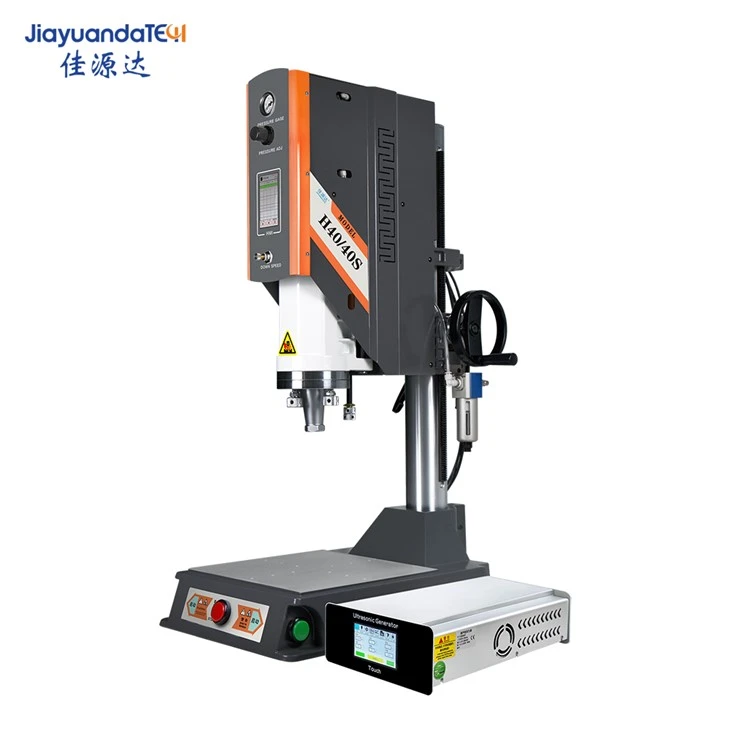


Ultrasound Plastic Welder
1. Efficiency: Fast welding speed, usually only 0.1~0.5 seconds;
2. Accuracy: High welding strength, beautiful appearance, suitable for precision parts;
3. Material: Welding thermoplastic materials such as ABS, PC, PP, etc.
Description:
Ultrasound plastic welder can weld many different plastic parts, including PP, PA, PC, ABS, Acrylic, nylon, etc. It can firmly weld two plastic parts of the same or different materials in a few seconds, with the advantages of high efficiency, low energy consumption and good quality. There is no obvious heat phenomenon during the welding process, the workpiece does not deform, and there is no irritating burning smell. It can replace traditional heat sealing and chemical reagent bonding processes to process plastic joints, which can not only greatly improve working conditions, but also increasing production efficiency. Besides, the thermoplastic molded plastic workpieces with complex shapes can also be welded firmly.
Features of ultrasound plastic welder:
1. Fast welding: Its welding speed is very fast. Most welding processes can be completed within 0.1~0.5 seconds, which is much faster than traditional welding methods. Therefore, it is very suitable for mass production operations;
2. Automatic frequency tracking: This function can make the machine's frequency consistent during operation, and will not cause damage due to frequency incoordination;
3. Optional mode: The operator can choose from the machine's welding mode and setting options, including energy, distance, peak power, time, etc.;
4. Controllable amplitude: The amplitude can be divided into stages and is adjustable within the range of 10-100%;
5. High-Q Ultrasonic transducer: higher energy receiving rate and conversion rate, not easy to break;
6. Abnormal protection: when the machine has abnormal voltage, current, load and other abnormal phenomena, the machine will automatically cut off the circuit to prevent damage;
7. Fast proofing: usually the mold will be completed within 15 days after receiving the sample (if we need customers to send samples);
8. Strict quality control: each machine is strictly tested before leaving the warehouse, and the machine has passed the CE certificate.
Product parameter
|
Products |
H40 series ultrasound plastic welder |
||||||||
|
working frequency |
15KHZ |
15KHZ |
15KHZ |
20KHZ |
20KHZ |
28KHZ |
30KHZ |
35KHZ |
40KHZ |
|
Working power |
4200W |
3200W |
2600W |
3000W |
2500W |
1200W |
1200W |
1200W |
800W |
|
Working voltage/gas source |
220V±10% / 0.2~0.7Mpa |
||||||||
|
Welding stroke |
100MM |
75MM |
75MM |
75MM |
75MM |
75MM |
75MM |
75MM |
75MM |
|
Dimensions mm |
750*900*1900 |
650*750*1880 |
390*630*1050 |
650*750*1880 |
390*630*1050 |
||||
|
Net weight |
≤260KG |
≤150KG |
≤85KG |
≤150KG |
≤85KG |
||||
|
Operation interface |
4.3 inch touch screen |
||||||||

What services can we provide?
1. Provide customizable solutions: We can provide customized design and services of ultrasound plastic welder according to the specific your needs, including machine size, horn size, welding frequency, power adjustment, logo, etc.;
2. Technical consultation and guidance: We can provide professional technical consultation to help the you choose the appropriate machine model and configuration based on product characteristics and production processes;
3. Online guidance for installation and debugging: We will arrange professional engineers to connect with you and guide the customer to operate the machine through video conference to ensure that the machine is correctly installed and can run stably. We will also train the operators online to make them familiar with the equipment operation process and maintenance knowledge;
4. 2-year warranty: Our products have passed many strict quality inspections. We are willing to provide you with a 2-year warranty period. During the warranty period, we will send repair parts to customers free of charge and guide repairs.
FAQ:
Q: Can ultrasound plastic welder welding plastic be waterproof?
A: Plastic ultrasonic welding can be waterproof, but it depends on the comprehensive effect of plastic material selection, ultrasonic line design, plastic part design, welding process parameters and other factors, so as to ensure the reliability of waterproof. Once a link goes wrong, it is easy to cause bad results.
Q: Why the ultrasonic welding joint is overloaded and does not emit waves?
A: Remove the mold and press the sound wave test to see if it is normal!
If it is still overloaded, adjust the frequency and reduce the current. If it cannot be adjusted, the machine is broken.
The reasons for the analysis are as follows:
The frequency of the transducer is wrong-the power board of the ultrasonic electric box is broken-the main board of the ultrasonic electric box is broken-the ultrasonic capacitor board is broken-or the frequency tuner is broken!
Q:Which plastic materials can be ultrasonically welded with PP plastic materials?
A: There are several methods for fastening and connecting plastic components:
1. Using adhesive (glue), the high corrosion of the adhesive causes the molecules on the surface to swell and restore their activity. Then, with the assistance of external forces, the molecules entangle with each other to achieve the welding purpose.
2. Directly use injection molding for secondary molding to achieve bonding effect.
3. Use ultrasonic welding. (What about other plastic welding methods?)
So what is ultrasonic plastic welder welding?
Almost all welding causes the molecules on the welding end faces of two types of welding parts to move, causing them to diffuse and entangle with each other, achieving the goal of mutual connection. Ultrasonic welding, on the other hand, utilizes the high-frequency vibration of the welding head to cause high-frequency friction between two welding parts, converting mechanical energy into thermal energy. The thermal energy dissolves the molecules on the two welding surfaces, restoring their activity. Then, with the assistance of external forces, the molecules entangle with each other to achieve the welding purpose, and the welding strength can be close to the strength of the raw material.
Q: What plastic has a better ultrasonic welding effect?
A: Amorphous polymers (ABS, PC, PS, PMMA, etc.): molecular arrangement is disordered, with obvious softening, melting, and flowing temperatures (Tg glass transition temperature). This type of resin is usually able to effectively transmit supersonic vibration and achieve good welding over a wide range of pressure/amplitude.
Crystalline polymers (PE, PP, POM, PA6, PA66, PBT, PET, etc.): The molecules are arranged in an orderly manner, with obvious melting points (Tm melting temperature) and re solidification points. Solid crystalline polymers are elastic and can absorb some high-frequency mechanical vibrations. So this type of polymer is not easy to transmit ultrasonic vibration energy to the bonding surface, which requires higher amplitude. High energy (high melting heat) is required to break the semi crystalline structure and change the material from a crystalline state to a viscous flow state, which also determines the clarity of the melting point of such materials. Once the melted material leaves the heat source, a decrease in temperature will lead to rapid solidification of the material.
Secondly, generally speaking, non polar compounds (such as PP, PE) are difficult to ultrasound (not impossible), polar compounds can ultrasound, and polar compounds can also ultrasound, such as ABS and PMMA.
In addition, there are some characteristics that can affect the effectiveness of ultrasound, such as hardness (generally higher hardness is better for ultrasonic welding), melting point (higher melting point requires more ultrasonic energy), purity (the welding effect of raw materials is good, but the effect of impurities doped with recycled materials is slightly worse).
For more details of Ultrasound Plastic Welder, please feel free to contact us!


Send Inquiry
