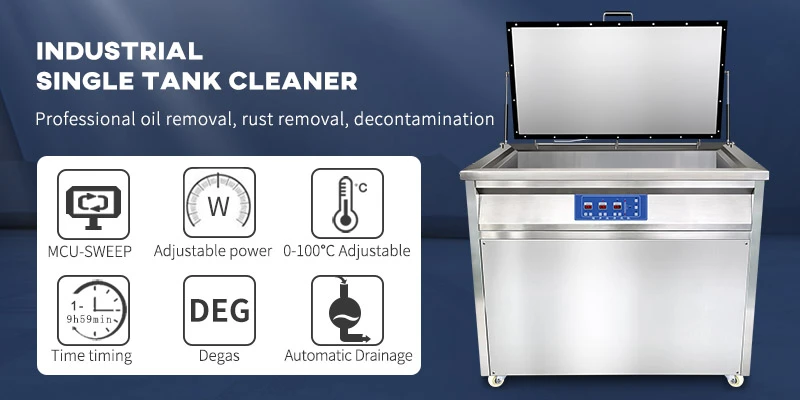
Selection of ultrasonic cleaning machine
Mar 17, 2023
1. Power selection
Ultrasonic cleaning effect is not necessarily the same as (power × Cleaning time) is proportional. Sometimes it takes a long time to remove dirt with small power. If the power reaches a certain value, sometimes the dirt will be removed quickly. If the selected power is too large, the cavitation intensity will be greatly increased, and the cleaning effect will be improved, but at this time, the more precise parts will also produce corrosion spots, which is not worth the loss. Moreover, the cavitation at the vibration plate at the bottom of the cleaning cylinder is serious, and the water spot corrosion will also increase. When using organic solvents such as trichloroethylene, there is basically no problem, but when using water or water-soluble cleaning fluid, it is easy to suffer water spot corrosion. If the surface of the vibration plate has been damaged, Cavitation corrosion is more serious under high power, so ultrasonic power should be selected according to actual use.
2. Frequency selection
The ultrasonic cleaning frequency ranges from 28kHz to 120kHz. When using water or water cleaning agent, the physical cleaning force caused by cavitation is obviously beneficial to low frequency, and generally about 2840kHz is used. For parts with small gaps, narrow slots and deep holes, it is better to use high frequency (generally above 40kHz), even hundreds of kHz. When cleaning clock parts, use 400kHz. If broadband frequency modulation is used for cleaning, the effect will be better.
3. Use of cleaning basket
When cleaning small parts, the net basket is often used. Because the mesh will cause ultrasonic attenuation, special attention should be paid. When the frequency is 28 khz, it is better to use a mesh of more than 10 mm.
4. Selection of cleaning fluid temperature
The most suitable cleaning temperature of water cleaning solution is 4060 ℃. Especially in cold weather, if the cleaning solution temperature is low, the cavitation effect is poor, and the cleaning effect is also poor. Therefore, some cleaning machines are equipped with heating electric heating wires around the outside of the cleaning cylinder for temperature control. When the temperature rises, cavitation is easy to occur, so the cleaning effect is good. When the temperature continues to rise, the gas pressure in the cavity increases, causing the impact sound pressure to drop, reflecting the multiplication of these two factors.
5. Determination of the amount of cleaning fluid and the position of cleaning parts
Generally, it is better that the liquid level of cleaning fluid is more than 100mm above the surface of vibrator. Due to the influence of the standing wave field, the amplitude at the wave node is very small, and the amplitude at the wave amplitude is large, resulting in uneven cleaning. Therefore, the best location for cleaning items should be placed at the wave amplitude.
6. Ultrasonic cleaning process and selection of cleaning solution
Before purchasing the cleaning system, the following application analysis should be carried out for the cleaned parts: to clarify the material composition, structure and quantity of the cleaned parts, and to analyze and clarify the dirt to be removed. These are the prerequisites for determining the cleaning method to be used and determining whether to use water-based cleaning fluid or solvent. The final cleaning process needs to be verified by cleaning experiments. Only in this way can we provide proper cleaning system, reasonably designed cleaning process and cleaning fluid. Considering the influence of the physical properties of cleaning fluid on ultrasonic cleaning, steam pressure, surface tension, viscosity and density should be the most significant factors. Temperature can affect these factors, so it will also affect the efficiency of cavitation. Any cleaning system must use cleaning fluid.