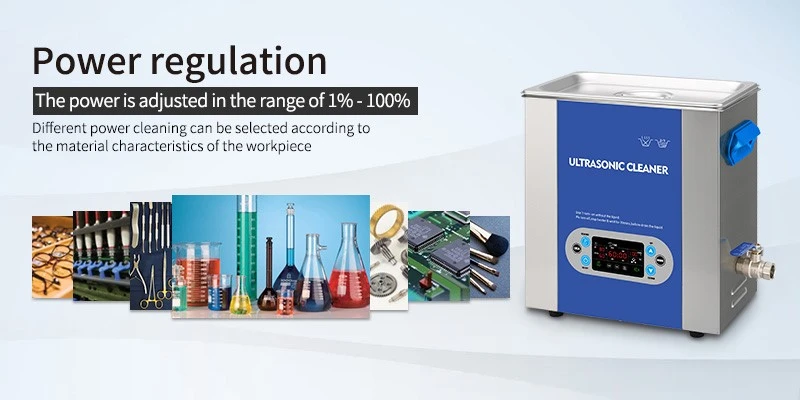
When selecting cleaning fluid, the following three factors should be considered
Mar 21, 2023
1) Cleaning efficiency: When selecting the most effective cleaning solvent, we must do experiments. If ultrasound is introduced into the existing cleaning process, the solvent used generally does not need to be changed;
2) Simple operation: the liquid used should be safe, non-toxic, easy to operate and long service life;
3) Cost: The use cost of the cheapest cleaning solvent is not necessarily the lowest. During use, the cleaning efficiency and safety of the solvent must be taken into account, as well as the number of workpieces that can be cleaned by a certain amount of solvent with the highest utilization rate. Of course, the selected cleaning solvent must achieve the cleaning effect and be compatible with the workpiece material to be cleaned. Water is the most common cleaning fluid, so the system using water-based solution is easy to operate, low in cost and widely used. However, some materials and dirt are not suitable for aqueous solutions, so there are many solvents to choose from.
Different cleaning fluids and different cleaning systems
Water-based system: It is usually composed of an open groove in which the workpiece is immersed. The complex system consists of multiple tanks, and is equipped with circulating filtration system, rinsing tank, drying tank and other accessories.
Solvent system: most of them are ultrasonic vapor phase degreasing cleaning machines, often equipped with continuous waste liquid recovery device. The ultrasonic vapor phase grease removal process is completed by an integrated multi-tank system formed by solvent evaporation tank and ultrasonic immersion tank. Under the combined action of hot solvent steam and ultrasonic shock, oil, grease, wax and other solvent-soluble dirt are removed. After a series of cleaning procedures, the workpiece is hot, clean and dry.
Treatment of cleaning parts
Another consideration of ultrasonic cleaning is the loading and unloading of cleaning parts or the design of tooling for placing cleaning parts. When the cleaning part is in the ultrasonic cleaning tank, neither the cleaning part nor the cleaning part basket shall touch the bottom of the tank. The total cross-sectional area of the cleaning part shall not exceed 70% of the cross-sectional area of the ultrasonic groove. Rubber and non-rigid plastic can absorb ultrasonic energy, so be careful when using these materials for tooling. Special attention should also be paid to insulated cleaning parts. The efficiency of the best ultrasonic cleaning system will be greatly reduced if the tooling basket is improperly designed or the workpiece is too heavy. Hooks, racks and beakers can be used to support cleaning parts.
Clarification of cleaning time, workpiece type and quantity
※ The machine working mode shall be fully automatic, semi-automatic and manual.
※ Machine size and cost.
Others
Parts with large amount of dirt shall be pre-cleaned by immersion, spray and other methods. After most of the dirt is removed, ultrasonic cleaning of the remaining dirt will have a good effect. When cleaning small items and items (parts) with complex shapes, uniform cleaning can be achieved by using a cleaning net or rotating the cleaning object and using ultrasonic radiation while vibrating.