Do you know the difference between spray cleaning machine and ultrasonic cleaning machine?
Sep 13, 2022
The cleaning field of industrial manufacturing can be mainly divided into ultrasonic cleaning, high-pressure spray cleaning machine and ultrasonic high-pressure spray combined cleaning.
The spray cleaning machine is mainly used to spray the workpiece surface by raising the water pressure to remove dirt. Generally, the spray cleaning pressure is between 0.3-0.8mpa. This method is simple to implement, easy to operate and has good effect. It is applicable to flat workpieces. However, it is difficult to clean places where jet water is difficult to reach, such as deep holes and blind holes.
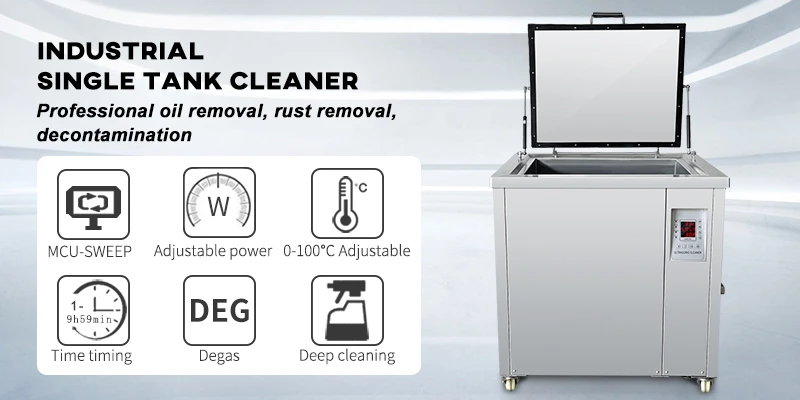
The ultrasonic cleaning machine mainly uses the cavitation effect of ultrasonic wave to form a huge impact around the workpiece, so that the dirt in the workpiece surface and gap can be peeled off quickly, so as to clean the workpiece surface. This cleaning method makes the cleaning of complex, curved and small workpieces convenient and feasible, and can realize automatic operation. Since the cleaning medium water contains a small amount of air, the ultrasonic effect of the ultrasonic cleaning machine will be weakened in a period of time after the initial cleaning or replacement of the cleaning medium. However, with the extension of the cleaning time, the air in the water will decrease, that is, after the "raw water" becomes "cooked water", the ultrasonic cleaning effect will be significantly improved. In addition, the optimal temperature for ultrasonic cleaning is 40 ℃ - 60 ℃.
The main purpose of ultrasonic high-pressure spray combined cleaning is to improve the cleanliness and cleaning efficiency of batch chemical parts from the appearance cleaning. The combination of the two can achieve a satisfactory cleaning effect. The whole cleaning process is carried out in the form of mesh belt or roller conveyor according to the design sequence, and workpiece overlap shall be avoided during use. There are many factors that affect the cleaning effect of workpieces, including water quality, cleaning temperature, cleaning time, cleaning solution composition, cleaning solution replacement cycle, compressed air (bubbling) quality, ambient air quality, placement posture and quantity of workpieces during cleaning, etc., which directly affect the cleaning effect. In addition, if there is water stain on the workpiece, the main reason is that the water quality or compressed air (air cutting) does not meet the requirements. Using deionized water and improving the purity of compressed air can effectively eliminate water stains